
The magical organ, MP (LMP, MMP)
Learn more about the magic system
Description
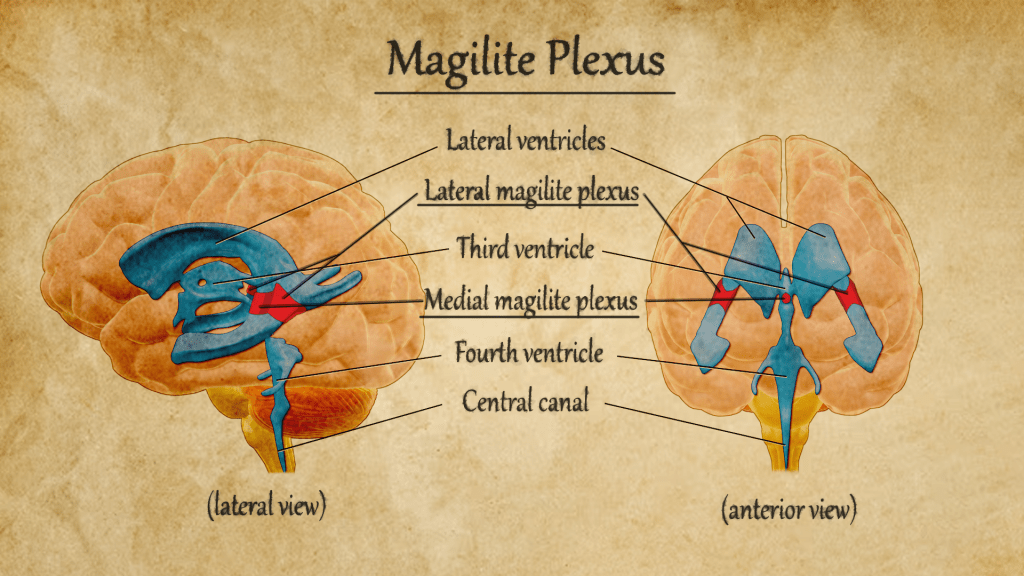
The magilite plexus is a group of subcortical structures located around the lateral ventricles and within the third ventricle of the brain. These structures are critical for the ability to use the latent magical potential (e.g., energy) of the magilite coursing through people’s veins.
The human magilite plexus is made up of three separate structures, the two lateral magilite plexuses (LMP) that integrate information from other brain regions, and the medial magilite plexus (MMP), that acts as a relay station, ultimately directing the magical commands through the central canal of the brainstem to the rest of the body and its magilite pathways.
Function
The magilite plexus is a complex hub of activity, integrating multiple brain regions in order to produce the phenomenon known as magic.

Prefrontal Cortex and the Primary Visual Cortex
Magic starts as activity (e.g., a decision) in the prefrontal cortex. The information travels from there to the back of the head, to the occipital lobe and its primary visual cortex (V1). In the primary visual cortex, the user visualizes the preferred outcome of his or her magic.
How well the physical output follows the desired outcome depends on a lot of factors, including the individuals proficiency with magic (can be trained), the individual’s inherent magical potential (typically stays stagnant over one’s life), the individual’s emotional state, and the elemental restrictions of the magic that the individual is attuned to.
As visualization is critical for magic, damage to the primary visual cortex (back of the head) severely impairs or even entirely takes away the ability to use and/or control the magic. Damage to this area is a likely contender to explain the phenomenon known as spontaneous self-combustion, as well as potentially explaining many cases of magilite imbalance.
The degree/accuracy of visualization is one of the primary determinants over one’s fine-tuned control of magic. The more accurately you can visualize what you want, the more fine-tuned your magic will tend to be.
In the case of automatic magical responses, as seen with many Elite Warriors and Captains reacting to attacks in a split second, the cerebellum takes over, enabling rapid evasion or attack without the need for conscious consideration and visualization. This however, like any complex skill, requires extensive practice.

Magic and The Limbic System
From the primary visual cortex (or the cerebellum), the information travels to the lateral magilite plexuses of each hemisphere. There, information from the limbic system (emotions and memory) are integrated, particularly from the amygdala and hippocampus.
The amygdala, which deals with the emotional aspects of stimuli, connects to the lateral magilite plexuses via the magamygdalic pathways. The amygdala, as well as playing a part in awakening the magic, allows the user to respond more vigorously to more threatening situations, when the emotions are high.
The hippocampus, a structure that deals with memory, connects to the lateral magilite plexuses through the magicampal pathways. The magicampal pathway retrieves elemental information from the users memories, essentially controlling what element of magic the user is able to use.
The hippocampus and magilite plexus are also connected to the eye through the the ocular nerve’s magilite pathway. The iris, which has an exceptional concentration of magilite, responds by changing its crystalline structure in response to feedback from the hippocampus and magilite plexus. This makes it possible to determine someone’s elemental attunement through their eye color!
The resulting crystalline changes in the iris give the eyes their faintly glowing colors, blue for the Lumare empire’s water magic sorcerers and red for the Kaligo empire’s fire magic sorcerers. This crystalline change is often reported as a brief, stinging or burning sensation.
As for non-magic users, the magilite simply floats around erratically, leading to the natural eye color being visible. Once the magic is awakened, i.e. the magicampal pathway is formed, feedback to the iris crystallizes the magilite, giving rise to the unique elemental color.

Elements – Magilite Plexus vs. Magilite Polyplexus
An individual’s elemental attunement is determined by the memories of the individual, which in turn are determined by the collective attunement and element of focus of his or her surrounding culture.
In humans, the magilite plexus (sometimes referred to as a monomagilite plexus) only supports a single bandwidth active connection at a time. This makes humans locked into a single element of magic (determined by which is learned first, and one’s culture).
What element is awakened in socially isolated individuals in various unique environments remains a mystery and requires further study.
Additionally, the single-bandwidth synapse of humans and its specific element becomes almost instantaneously fixed in place, like water only running down a particular groove once it is formed.
If the groove problem were to be overcome by forming an additional “groove”, it may theoretically be possible for humans to use multiple elements of magic, albeit likely only a single one at a time. Of intrigue is the question of split-brain subjects. Split-brain subjects may even be able to use two different types of magic simultaneously due to the lateral magicampal pathways not firing synchronously, however, this also requires further study.
Abscondita (Albinar), who have a magilite polyplexus (poly = latin for many), have magilite plexuses that are able to sustain multiple bandwidth connections at the same time, each for a different element. This effectively allows them to use multiple elements of magic at the same time, resulting in vivid, rainbow-like eye colors, shifting whenever a different element is in use.
What makes it possible for the abscondita to use multiple elements at once are the structural differences in the magicampal pathway, as well as differences in how their medial magilite plexus handles input from the lateral magilite plexuses.

Synapses -> Magic
The medial magilite plexus, located within the third ventricle in the middle of the brain, integrates the information coming from both of the lateral magilite plexuses of each hemisphere. It then sends information to the somatosensory cortex, which produces the tingly and magnetic “feeling” of using magic, as well as to the motor cortex, which produces the signals for the actual movement of magilite within the body.
From the motor cortex, the information flows back through the medial magilite plexus to the fourth ventricle and through the central canal of the brainstem to the spinal column.
From the spine, the magilite pathways flow outward to the periphery of the body, allowing the concrete effects of magilite to be activated both within the body and outside of it. Within the body typically implies either the use of magistrength enhancing or age stasis, whereas external/peripheral uses typically imply actual visible magic (e.g., fire, water spells).
Sometimes, magilite goes haywire and produces nasty physical complications (e.g., fire in the guts), often resulting in death without proper emergency care and/or silver magic blocking devices.

 The World Stones