
Andaril is the name of the planet that TWS takes place on, though today, it is commonly referred to as Andril, or simply just Ann.
The name Andaril originates from the sanskrit words Anda (meaning “egg” or “celestial sphere“), Ri (meaning “to move/reach/rise“) and the hebrew word El (meaning “God“), which together makes it The Ascending Egg of God.
Why this name? Because Atlas (the Creator God of TWS) created Andaril for the sole purpose of incubating his own power (which he distributed into Andaril as magilite), so that it could evolve into something greater, into a power that may aid him in his millennia-spanning conflict against another god, The Satan of Earth.
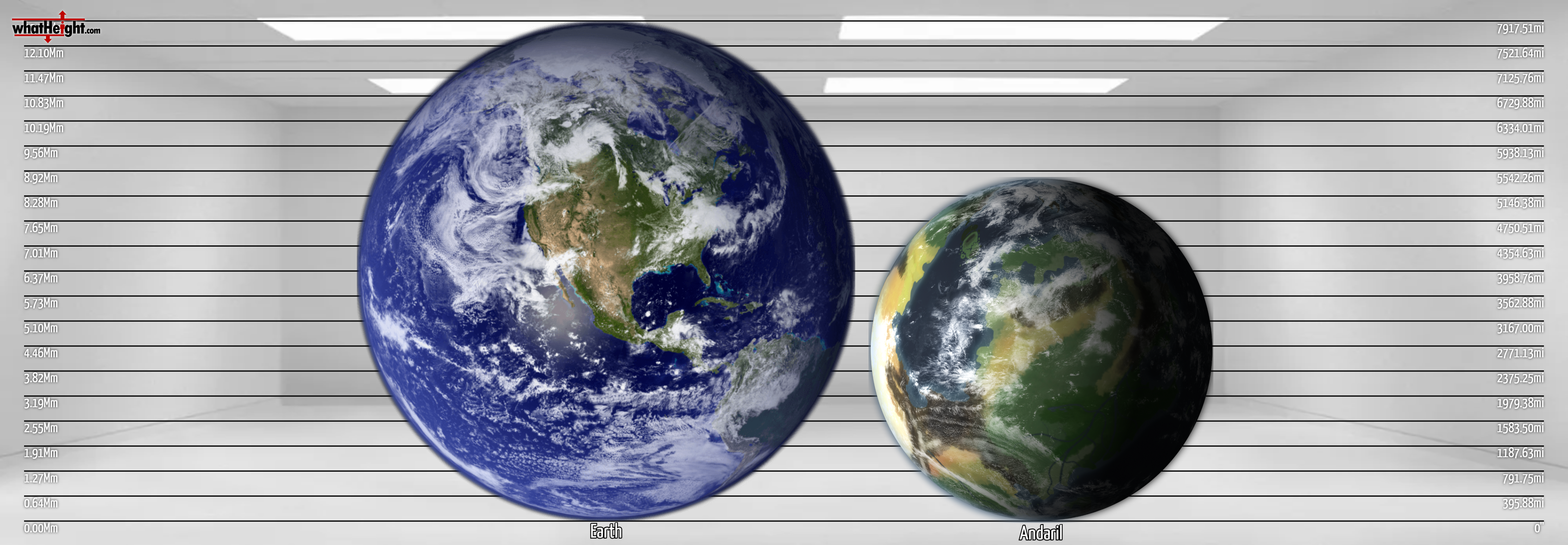
Planetary stats
- Diameter: 8,807.6 km
- Radius: 4,403.8 km
- Circumference: 27,670 km
- Surface area: 243M km2 (vs. Earth’s 510M km2)
- Population modifier (e.g., converting the population density/rarity of Earth creatures to Andaril, and vice versa): 48%
- Oceanic depth (avg): 4.5km (deepest point is 15km)
- Volume: 357B km3
- Mass: 2.85 * 1024 kg (48% of Earth’s mass)
- The higher density, as caused by more, heavier metals in the core (7.98 g/cm3 vs Earth’s 5.51 g/cm3), is what gives the planet the same gravity as Earth, despite the smaller size of the planet, albeit with a stronger magnetosphere
- Gravity: 9.81 m/s2
- Escape velocity: 9.29km/s (vs. Earth’s 11.18 km/s)
- Rotational speed: 1,153 km/h (equatorial) -> Days are 24h long
- Axial tilt: 18° -> milder seasons than on Earth (23.5°)
- Atmosphere: 1 Bar, 17°C, 35% O2, 61.8% N, 3% Ar, 0.2% CO2
- Moon(s): Andaril has a rocky moon the size of Pluto, with a diameter of 2,404km, and a distance from Andaril of 266,000 km
Nations
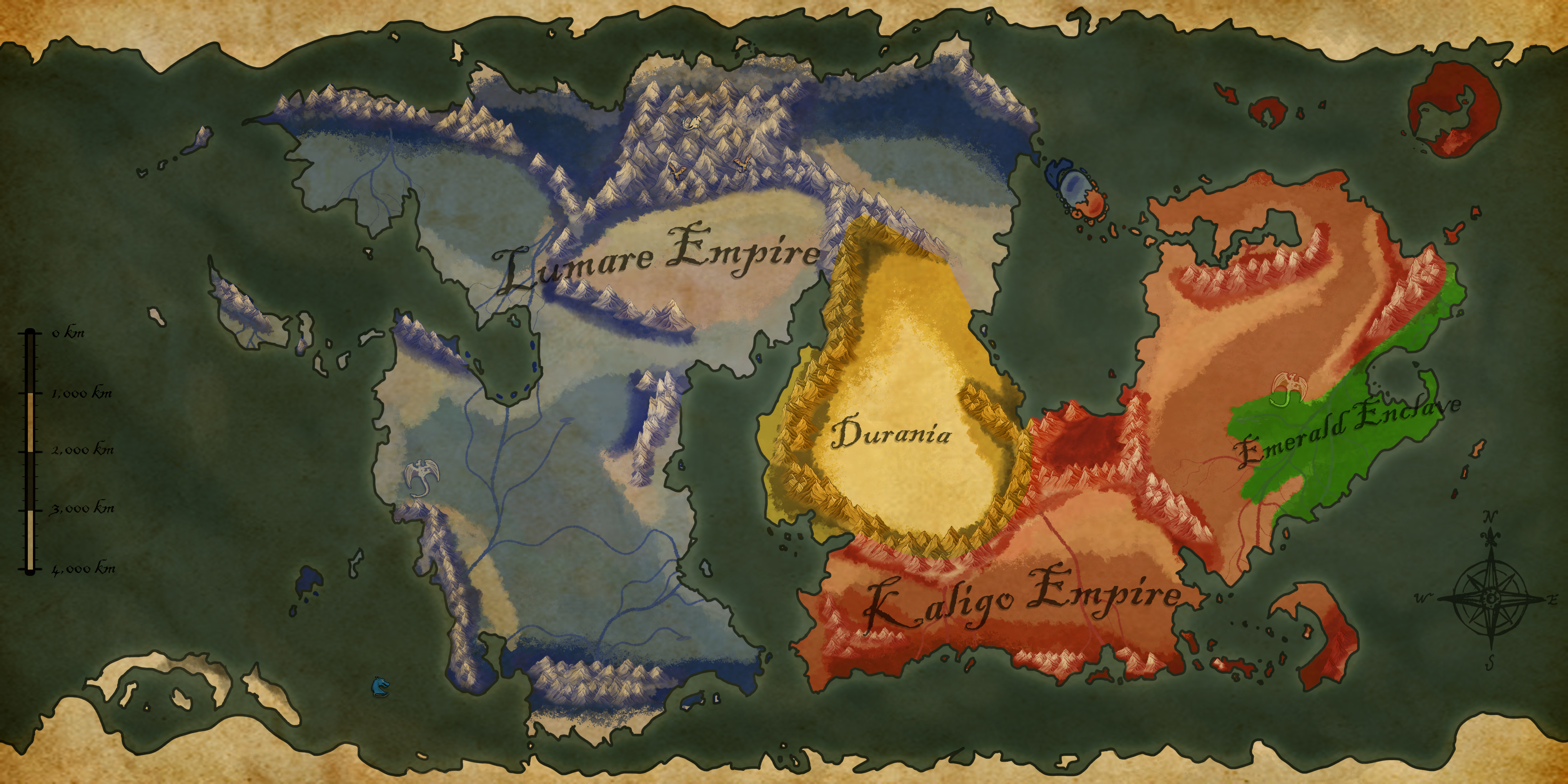
- Lumare Empire: the Nation of Water
- Kaligo Empire: the Nation of Fire
- Durania: The Nation of the Sun
- Emerald Enclave: The Nation of the Forest
Geography
Andaril is characterized by a single massive supercontinent, surrounded by a dozen or so larger islands mostly secluded from the rest of the world’s workings, as well as plenty of unexplored wilderness, smaller islands, and other regions avoided for superstition, danger, and cost reasons.
While most of the major subcontinents and geographical landmarks are accurately mapped and their ownership claimed, a massive chunk of the world’s land remains fully wild and uninhabited. Despite the size of the planet, the land is almost exclusively controlled by just the four largest nations in the world, with the Lumare and Kaligo Empires laying claim to nearly all the land on the planet.
The Lumare Empire to the west and northwest, spanning over ten-thousand kilometers in height, and over twelve-thousand kilometers in width, easily controls the largest chunk of the world’s geography, with the Kaligo Empire coming in close second with their southeastern section of the world spanning six-thousand kilometers in width and around eleven-thousand kilometers in height.
Due to the axial tilt, the seasons on Andaril, while certainly still distinct, are slightly milder than on Earth. The average global temperatures are a touch higher than on Earth, partly due to the higher CO2 content, hovering around 17 degrees celsius.
All the biomes you might find on Earth are also present in Andaril, with varying prevalences and sizes. Fertile grasslands, forests and steppes dominate the Western hemisphere, with the largest mountain-range being found right at the northern edge of the Lumare Empire, bordering on the northern ice sheets. The southeast, the land of the Kaligo Empire, is mostly arid and mediterranean, with the southern sections being dominated by temperate forests and hills.
In the middle of the world sits The Great Desert and its surrounding mountain range, dividing the two largest nations geographically. The passages both south and north of the desert are tightly controlled by the oldest nation in the world, the hardy, sun-worshipping trade nation of Durania.
To the west of the Durania lies a massive inland sea, separating Durania from the Lumare Empire, and putting even more geographical distance between the Lumare and Kaligo empires. The southern strait connecting the eastern Kaligo Empire to the western Lumare Empire has subsequently turned into a prime hotspot for the four-century-long war, becoming peppered with forts over the last few centuries, and forcing the surrounding villages to fortify their farmsteads.
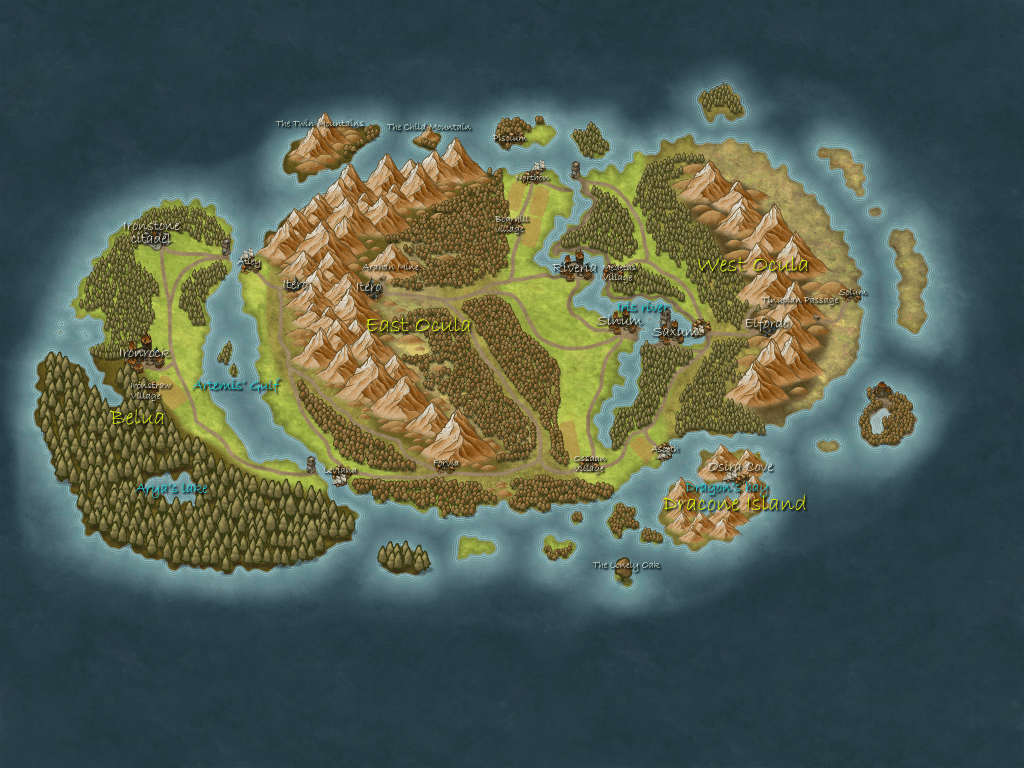
Another heavily war-ravaged area is the northeastern island of Ocula, a massive island partially controlled by both warring nations, centered right in the middle of the two subcontinents and their capes, a pitstop between the territories of the two empires. The subcontinents to the northeast are otherwise separated by a large gulf, spanning all the way to eastern sections of Durania, where the sand meets the sea, making the island of Ocula the most valuable asset in the war and a prime target for both nations. While the island easily has the greatest number of battles, the continental capes of each nation also see few peaceful months.
To the very east lies the rainforest nation of guerilla survivalists, the Emerald Enclave, the only nation that functions strictly as a democracy. Despite a century of attempts, the Kaligo Empire never managed to gain control of the dense forests, instead making the nation ally themselves with the Lumare Empire.
Continents, Cities, Villages, and more
(to be added)
Ocula

